

Sluggers Triple Chamber Vape: What B2B Buyers Should Know About Multi-Chamber Hardware Reliability

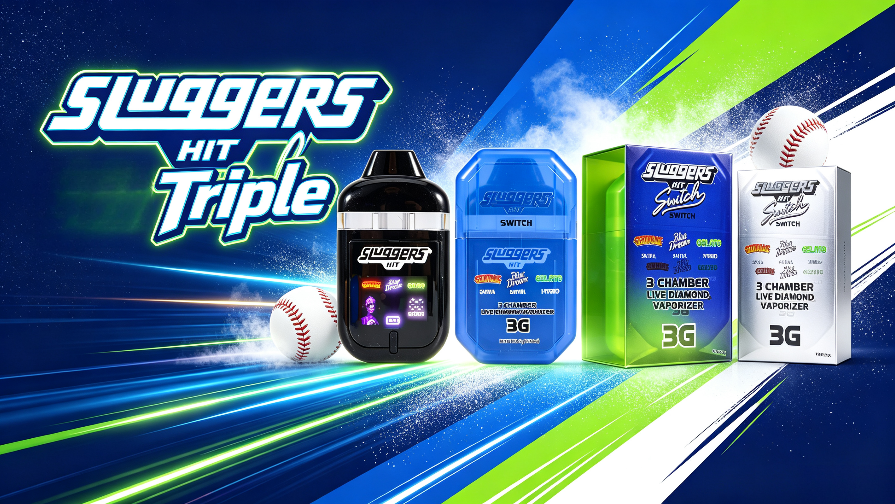
Exploring the Best Sluggers Triple Disposable Vapes for Sale: Top Brands and Flavors
Search interest around “sluggers triple disposable for sale” reflects a bigger change taking place in the U.S. cannabis vape business.
The market is moving beyond the traditional choice between a single-flavor cartridge and a basic all-in-one device. Multi-chamber hardware is introducing a new merchandising proposition: several formulations, multiple combinations, and an interactive hardware experience inside one device.
Sluggers is one of the brands testing that concept at commercial scale.
Its current Super Switch platform uses a 3g, three-chamber configuration containing three separate varieties that can be selected individually or combined, creating seven possible combinations. Sluggers’ current catalog shows approximately 19 Super Switch listings, while its Triple Switch bundle groups three different three-chamber devices around contrasting flavor profiles.
For an ordinary shopper, that sounds like product variety.
For a U.S. cannabis purchasing manager, distributor, or OEM product-development team, it raises more strategic questions:
Is multi-chamber hardware becoming commercially meaningful? Is Sluggers’ vape business actually growing? Which flavor combinations make sense at retail? And can a three-chamber device deliver acceptable reliability at scale?
Those questions are worth examining because both Sluggers and the wider disposable category are changing quickly.
Sluggers’ Vape Business Is Growing Faster Than the Brand Overall
The first reason procurement teams should pay attention is sales momentum.
Headset’s August 2026 brand snapshot shows Sluggers Hit generating more than $1 million in tracked July sales, with total brand sales up approximately 40.1% year over year.
More importantly, Vapor Pens represented 25.4% of Sluggers’ tracked sales and grew approximately 71% year over year—substantially faster than the overall brand. Pre-Rolls still dominate at 66.5% of sales, but vape has clearly become a meaningful secondary category rather than an experimental side product.
Sluggers also had meaningful geographic reach. Headset reported the brand in 995 licensed dispensaries across California, New York, and three additional states, including 713 California locations. In July 2026, Sluggers ranked No. 24 in California Vapor Pens and No. 18 in Arizona Vapor Pens.
For buyers, that distinction matters.
This is not simply a social-media product concept looking for a market.
There is measurable vape-category growth behind the brand.
The Wider Market Is Moving Toward All-in-One Vapes
Sluggers’ expansion is happening during a structural change in U.S. cannabis vape.
BDSA reported in July 2026 that disposable vape sales had surged approximately 41%, from $2.7 billion to $3.8 billion, while cartridge sales declined about 14%, from $4.85 billion to $4.19 billion.
The crossover occurred in April 2026, when monthly disposable revenue exceeded cartridge revenue nationally for the first time. BDSA described the shift as a fundamental restructuring of the category, driven by convenience, portability, price competition, and the growth of larger-capacity all-in-one products.
Headset had already identified the same direction earlier in 2026.
In Q4 2025, all-in-one disposables represented 46.7% of U.S. Vapor Pen sales, up 20.8% year over year. Larger formats were gaining particularly quickly: U.S. 2g Vapor Pen products grew 95.8% year over year, even while 1g remained the dominant size.
The implication for purchasing managers is straightforward:
The market is already comfortable moving beyond traditional small-format vape hardware.
Three-chamber products represent another step in that evolution.
What Exactly Is the Sluggers Super Switch?
Current Sluggers product documentation describes the Super Switch as a 3g all-in-one vaporizer containing three separate chambers.
Each chamber contains a different formulation. The user can select one chamber or combine multiple chambers, producing seven possible combinations from the three available options. Current product pages also describe an integrated light-based “Home Run” scoring interface.
From a procurement standpoint, those features matter for two reasons.
First, three chambers increase merchandising density. Instead of dedicating one piece of hardware to one flavor or formulation, a brand can present three profiles inside one SKU.
Second, they substantially increase engineering complexity.
A conventional single-chamber all-in-one primarily requires consistent performance across:
battery → PCB → heating element → reservoir → airflow.
A three-chamber platform adds:
three reservoirs + three heating channels + chamber-selection logic + combination modes + more complex firmware + additional seals and fluid paths.
That creates differentiation.
It also creates more opportunities for failure.
Why Multi-Chamber Hardware Appeals to Retail Buyers
Retail shelf space is expensive.
Every additional SKU consumes inventory capital, display space, employee training time, forecasting resources, and replenishment capacity.
A multi-chamber format can potentially compress several experiences into one SKU.
Imagine a retailer deciding between three separate single-flavor products and one three-chamber product offering the same broad flavor families.
The multi-chamber model can potentially create:
- higher perceived product differentiation;
- a stronger premium price story;
- fewer individual SKUs;
- greater flavor variety per unit;
- more distinctive merchandising;
- and a stronger launch narrative.
That does not automatically make it more profitable.
But it gives brands something increasingly difficult to achieve in cannabis vape:
visible hardware differentiation.
As disposable formats become more common, another rectangular all-in-one device becomes increasingly difficult to distinguish from competitors.
Multi-chamber architecture gives the hardware itself a reason to exist.
Current Sluggers Triple Flavor Strategy: Variety Matters More Than One “Best” Flavor
The phrase “top flavors” is often handled poorly in vape content.
A B2B purchasing manager should not make inventory decisions based on an editor declaring one strain or flavor “the best.”
The more useful question is:
How is the assortment structured?
Sluggers’ current Super Switch lineup shows a deliberate strategy of combining contrasting flavor families inside each device.
Current configurations include:
- Pineapple Express × Lemon Haze × Runtz
- Grape × Berry Breeze × Cherry Gelato
- NYC Diesel × Mojito × Bubble Bath
- Mango Sherb × Peach Dreamz × Rainbow Runtz
- Blue Dream × Gelonade × Gelato
- Watermelon Z × Pink Acai × Apples & Bananas
- Rainbow Road × Lemon Lime × Purple Punch
- Strawberry Cooler × Honey Banana × Gelato 41
- Strawberry Kiwi × Pina Colada × Apples & Bananas
Sluggers’ current official collection includes roughly 19 Super Switch product results across its different channels.
The important merchandising pattern is not the individual name.
It is contrast.
Fruity profiles sit beside citrus, creamy, berry, gassy, tropical, or dessert-oriented profiles.
That creates a stronger reason to switch chambers than placing three nearly identical profiles inside the same device.
The Triple Switch Bundle Makes the Assortment Strategy Even Clearer
Sluggers currently markets a Triple Switch bundle containing three Super Switch devices.
The bundle groups:
Mango Sherb × Peach Dreamz × Rainbow Runtz around fruity/sweet positioning;
NYC Diesel × Mojito × Bubble Bath around gassy, minty, and floral positioning;
and Grape × Berry Breeze × Cherry Gelato around berry/sweet positioning.
For B2B buyers, that structure illustrates a useful assortment principle.
A multi-chamber product should not simply offer “three more flavors.”
Each SKU should occupy a recognizable merchandising territory.
A category manager can then build an assortment around distinct profiles rather than carrying ten devices that compete for essentially the same customer.
What Buyers Can Learn From Sluggers’ Product Mix
Sluggers is especially interesting because vape is not its original dominant business.
Pre-Rolls still represent approximately 66.5% of tracked sales, compared with 25.4% for Vapor Pens. Yet vape sales are growing significantly faster—about 71% year over year versus roughly 30.7% for Pre-Rolls in Headset’s July 2026 snapshot.
That makes Sluggers a useful example of category extension.
For a cannabis brand with established recognition in flower, pre-rolls, or concentrates, an integrated vape can provide another way to monetize brand equity.
But the hardware must support the brand promise.
If a premium pre-roll brand launches a complicated three-chamber vape and customers experience:
leaking, clogging, dead batteries, chamber failures, incorrect switching, or inconsistent heating,
the hardware problem quickly becomes a brand problem.
That is why procurement has an outsized role in category expansion.
Three Chambers Require More Serious QC Than One
A supplier may describe multi-chamber hardware as simply “three tanks in one device.”
That description understates the engineering challenge.
Procurement teams should validate each channel independently and in every supported combination.
For a three-chamber device, testing should include at least:
Chamber A only
Chamber B only
Chamber C only
A + B
A + C
B + C
A + B + C
That is seven operating modes before considering battery state, storage condition, viscosity, or temperature.
The OEM also needs to demonstrate that the electronics correctly manage current when multiple heating elements are operating.
A device that passes a single-channel test does not automatically pass a three-channel test.
Multi-Chamber Hardware Makes BOM Control More Important
The larger the number of components, the more damaging uncontrolled substitutions become.
Suppose the approved sample uses one ceramic heating element but mass production substitutes another with slightly different resistance.
In a single-chamber product, the effect may already be significant.
In a three-channel platform, different heater tolerances can create noticeably different behavior between chambers inside the same device.
That is particularly damaging because users can compare them directly.
OEM buyers should therefore establish a locked bill of materials covering:
- battery cell;
- PCB/PCBA;
- charging IC;
- firmware;
- heating elements;
- reservoir materials;
- seals;
- adhesives;
- housing;
- wiring;
- and charging components.
Any component change should trigger a documented change-control process.
Battery Performance Becomes More Important as Hardware Gets More Complex
Multi-chamber devices place greater demands on their electrical systems, particularly when more than one chamber can operate simultaneously.
Procurement managers should therefore look beyond a simple mAh claim.
The supplier should provide documented specifications for:
- rated capacity;
- nominal voltage;
- discharge capability;
- voltage under load;
- low-voltage cutoff;
- charging current;
- charging time;
- overcurrent protection;
- short-circuit protection;
- and cycle performance.
Lithium battery transportation requirements also apply.
PHMSA guidance states that lithium cells and batteries—including batteries installed in products—are covered by UN 38.3 test-summary requirements, and the relevant information must be made available to parties in the supply chain upon request.
A serious OEM supplier should be able to produce that documentation without hesitation.
A 3g Device Increases the Cost of Hardware Failure
Larger and multi-chamber formats can increase perceived value.
They also increase the amount of product affected by a single hardware failure.
This is a basic procurement-risk equation:
More product inside one device = higher economic exposure per failed device.
If a small-capacity vaporizer stops operating near the end of its intended lifecycle, relatively little product value may remain.
If a 3g three-chamber device experiences a battery, PCB, or charging failure early in its lifecycle, significantly more filled product may become unusable.
The appropriate response is not to avoid larger devices.
It is to apply higher reliability standards to them.
For a high-capacity program, purchasing teams should pay particular attention to:
battery endurance, recharge cycles, clogging over time, leakage during storage, channel consistency, and long-duration aging tests.
Price Compression Makes Differentiation More Valuable
Another reason triple-chamber platforms are emerging is that conventional vape hardware is becoming increasingly commoditized.
Headset reported average U.S. Vapor Pen pricing of approximately $21.81 per gram equivalent in Q4 2025, down roughly 11% year over year.
When pricing declines across a category, brands face two basic choices:
compete harder on cost
or
give retailers and customers a stronger reason to pay more.
Multi-chamber hardware is one attempt at the second strategy.
Instead of adding capacity alone, the product adds interaction and variety.
For procurement managers, that means the device should be evaluated not solely against another 3g product.
Compare its economics against the incremental retail value created by the hardware experience.
Do Not Confuse Sluggers’ Different Commercial Channels
This is an important supplier-verification issue.
Sluggers’ main brand site identifies current activity in markets including California, New York, Arizona, Massachusetts, and Canada, while Headset tracks Sluggers products across licensed dispensaries.
Separately, Sluggers also operates an online shop that describes products as hemp-derived THC offerings. Its current Super Switch pages there identify 3g THCp products and direct-to-consumer-style online offerings.
For procurement managers, those channels should not automatically be treated as interchangeable.
Before sourcing any Sluggers-branded SKU, determine:
Which legal entity is supplying it?
Which regulatory channel does that exact product belong to?
Which state is it intended for?
What testing applies?
What licenses or authorizations govern the transaction?
Does the specification match the version sold in the target market?
A product name alone does not answer those questions.
Verify Licensed Supply Independently
California provides a particularly useful example because it remains central to Sluggers’ distribution.
The California Department of Cannabis Control maintains a license-search database that is updated daily. Buyers can use it to verify whether a cannabis business holds an active license and whether that license permits the relevant commercial activity.
DCC explicitly recommends vetting commercial partners before entering business transactions, including confirming that cannabis businesses hold the appropriate licenses.
For procurement departments, supplier verification should happen before price negotiation becomes serious.
A low quotation from an unclear supply chain is not a purchasing advantage.
It is unresolved commercial risk.
California Buyers Should Also Watch the Word “Disposable”
There is an important distinction between SEO terminology and compliant regulatory terminology.
Consumers—and search engines—commonly use phrases such as “Sluggers Triple disposable.”
California’s Department of Cannabis Control, however, refers to battery-integrated products as integrated cannabis vaporizers.
California rules prohibit cannabis vape packaging and labeling from saying or implying that cartridges or integrated vaporizers can simply be disposed of in ordinary trash or recycling. Marketing materials must also display prescribed hazardous-waste disposal messaging.
Those requirements have applied since July 1, 2024.
For B2B marketers, the lesson is valuable:
A high-volume SEO keyword does not automatically belong on regulated packaging.
Search content, product labels, advertisements, and distributor materials should each undergo the appropriate compliance review for the target jurisdiction.
“Top Flavor” Decisions Should Be Based on Sell-Through
Procurement managers should avoid selecting flavors simply because the names sound marketable.
Instead, build a SKU-level measurement framework.
For every Super Switch-style configuration, track:
- weekly unit velocity per store;
- reorder rate;
- average days to reorder;
- realized retail price;
- promotional discount rate;
- gross-margin dollars per SKU;
- return and complaint rates;
- geographic performance;
- and cannibalization between similar flavor profiles.
After several replenishment cycles, the data will tell you which flavor families deserve additional inventory.
A purchasing manager’s “favorite” flavor is irrelevant.
The retailer’s sell-through data is what matters.
Avoid Over-Assorting a Three-Chamber Platform
Multi-chamber products already deliver substantial variety inside each SKU.
That means brands may not need as many individual SKUs as they would with a conventional single-flavor vape.
Sluggers’ current lineup demonstrates how quickly a Super Switch family can become broad, with roughly 19 listings appearing in its current collection.
For distributors, the risk is inventory fragmentation.
If a retailer carries ten triple-chamber configurations, it is effectively presenting 30 underlying flavor positions plus multiple possible combinations.
That can be powerful.
It can also make replenishment difficult if demand is spread too thinly across the assortment.
An opening order should therefore emphasize distinct flavor territories and then expand based on sell-through.
What to Ask a Multi-Chamber Vape OEM Supplier
If your company is developing an original multi-chamber hardware program for a lawful market, use a more demanding RFQ than you would for a basic all-in-one.
Hardware Architecture
Ask for:
- chamber count and capacity;
- heating-element resistance;
- channel-selection logic;
- simultaneous-channel behavior;
- battery specification;
- PCBA design;
- charging architecture;
- and firmware documentation.
Quality Testing
Request evidence covering:
- individual chamber activation;
- every supported chamber combination;
- leakage;
- clogging;
- airflow;
- charging;
- output consistency;
- low-battery behavior;
- storage aging;
- and temperature cycling.
Formulation Testing
Test each intended formulation in the actual chamber where it will be used.
A device containing three different formulations can fail even if two work perfectly and the third does not match the hardware.
Battery Documentation
Require the correct UN 38.3 test summary for the production battery and confirm that the battery represented in the document is the one installed in mass production.
Change Control
Lock the BOM and require written approval before changes to the:
battery, PCB, heater, reservoir, seals, charging IC, firmware, materials, or manufacturing process.
Traceability
Each finished-product lot should be traceable to component lots and QC records.
When three separate heating systems are incorporated into one device, traceability becomes even more valuable during root-cause analysis.
Do Not Copy a Successful Branded Product for an OEM Program
The commercial success of a recognizable multi-chamber device can naturally attract private-label interest.
But there is an important difference between:
developing an original three-chamber product architecture
and
reproducing another company’s branding, packaging, industrial design, trademark, or distinctive trade dress.
For legitimate Sluggers-branded sourcing, buyers should independently verify authorization and the applicable commercial channel.
For a private-label project, develop original branding and an appropriately differentiated product.
A strong OEM partner should be able to create value through engineering and customization rather than simply copying a recognized product.
What Makes a Reliable Supplier More Valuable Than a Cheap Supplier?
Consider a hypothetical 50,000-unit three-chamber hardware program.
Supplier A is $0.30 cheaper.
The apparent saving is:
50,000 × $0.30 = $15,000.
But Supplier A changes battery cells without approval and generates a higher field-failure rate.
The true cost may include:
lost filled product + replacement devices + customer-service labor + retailer credits + freight + quarantined inventory + damaged buyer relationships.
Supplier B may have a higher initial price but provide:
locked BOM + traceable battery + stronger QC + aging tests + documented CAPA + replacement support.
The purchasing decision should therefore be based on total cost of quality, not only FOB cost.
The more complex the hardware, the more important that distinction becomes.
What Sluggers’ Growth Tells the Market
Sluggers presents an interesting 2026 case study.
The overall brand is growing around 40% year over year, while Vapor Pens are growing approximately 71%. Vape already represents roughly a quarter of tracked brand sales.
At the same time, the national disposable category has expanded dramatically, reaching approximately $3.8 billion in trailing sales and overtaking cartridges on a monthly basis during 2026.
The intersection of those two trends helps explain why products such as the three-chamber Super Switch are attracting attention.
Consumers are increasingly comfortable with integrated vape hardware.
Brands now need another layer of differentiation.
Multi-chamber technology attempts to provide it.
The Bottom Line
Interest in sluggers triple disposable for sale is not only about another disposable vape entering the market.
It reflects a broader hardware transition.
Sluggers’ current Super Switch platform combines 3g total capacity, three independent chambers, seven possible chamber combinations, and a growing range of flavor configurations.
Meanwhile, Sluggers’ tracked Vapor Pen business grew about 71% year over year in July 2026, while the broader U.S. disposable category grew approximately 41% to $3.8 billion in BDSA’s latest reporting.
Those numbers make multi-chamber hardware worth watching.
But they do not make every multi-chamber product a good purchasing decision.
Professional buyers should evaluate:
real sell-through, licensed-market fit, supplier authorization, chamber consistency, formulation compatibility, battery performance, UN 38.3 documentation, BOM control, lot traceability, warranty policy, and total cost of quality.
The winning three-chamber platform will not necessarily be the device offering the largest number of flavors.
It will be the platform that can deliver variety without sacrificing reliability.
Evaluating a Triple-Chamber Vape Hardware or OEM Program?
For companies operating in lawful, appropriately licensed markets, the most useful next step is technical due diligence rather than choosing a product from photographs or promotional claims.
For established branded goods, independently verify the applicable license, authorization, product identity, and commercial channel before proceeding.
For original private-label hardware development, evaluate OEM partners based on a production-representative sample, locked BOM, multi-channel testing data, battery documentation, formulation compatibility, QC procedures, lot traceability, change control, and after-sales support.
A qualified hardware partner should be able to discuss engineering, reliability, battery safety, customization, compliance requirements, production capacity, MOQ, lead time, and corrective-action procedures with the same confidence that it discusses price.
That is the supplier capability worth looking for as multi-chamber vape hardware moves from novelty toward a more serious product-development category.