

Blinkers Dual Chamber Vape: What B2B Buyers Should Know About Multi-Flavor Hardware and OEM Sourcing

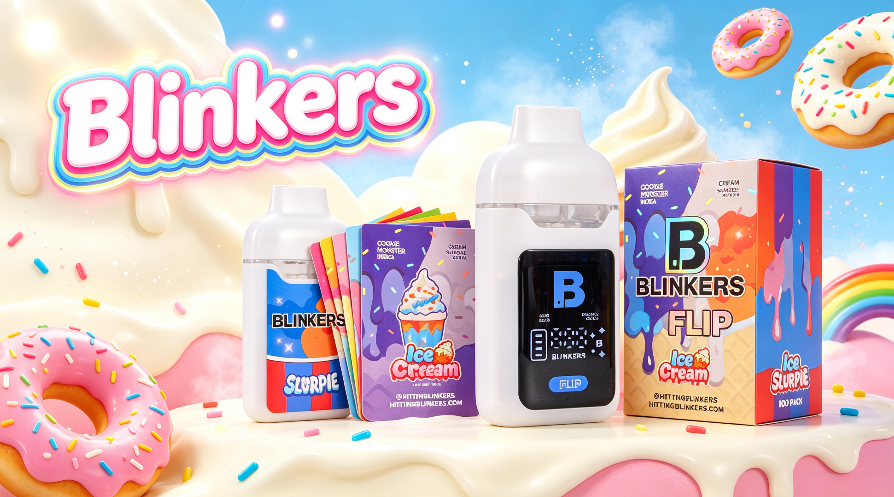
The Rise of Disposable Blinkers Vapes: A New Era in Vaping Convenience
The U.S. cannabis vape market has reached an important turning point.
For years, cartridges dominated the category. In 2026, that changed.
BDSA reports that U.S. cannabis vape generated approximately $8 billion in retail sales during the 12 months ending May 2026, representing about 26% of total cannabis retail sales. More significantly, disposable vape sales surged approximately 41%, from $2.7 billion to $3.8 billion, while cartridge sales declined 14%. Disposables overtook cartridges nationally for the first time in April 2026, and the gap widened in May.
That shift helps explain growing commercial interest around the disposable Blinkers vape category.
Blinkers-branded products currently marketed online include 2G all-in-one devices, larger-capacity formats, LED models, and dual-chamber “Flip” configurations. Public product pages emphasize rechargeable hardware, ceramic heating technology, flavor variety, product verification, and all-in-one convenience.
For consumers, those features translate into convenience.
For distributors, licensed retailers, brand operators, and OEM purchasing managers, they represent something more important:
a rapidly evolving hardware format with growing demand—but also greater requirements for quality control, supply-chain verification, battery documentation, and product differentiation.
The rise of disposable Blinkers-style products therefore provides a useful case study for understanding where the wider cannabis vape market is going next.
Disposable Vape Is No Longer a Secondary Format
The most important market change is that the disposable category has moved beyond being an alternative to cartridges.
It is becoming a primary format.
Headset’s February 2026 analysis showed all-in-one disposables reaching 46.7% of U.S. Vapor Pen sales in Q4 2025, up 20.8% year over year. Cartridges still held 53.1% at that point, but their share was declining.
Only a few months later, BDSA’s national tracking showed disposables moving ahead.
During the 12 months ending May 2026, disposable retail sales reached approximately $3.8 billion, while cartridges generated roughly $4.19 billion. Monthly disposable revenue surpassed cartridge revenue in April 2026.
For procurement managers, that crossover matters because assortment strategies built around historical cartridge dominance may now be backward-looking in some markets.
The question is no longer whether disposables deserve shelf space.
The question is:
How much shelf space should they receive, which architectures deserve investment, and which suppliers can deliver them reliably at commercial scale?
Why Convenience Has Become a Product Platform
The first generation of disposable cannabis vapes competed primarily on simplicity.
The proposition was straightforward: no separate battery, no threaded cartridge, no setup.
Today’s all-in-one hardware is becoming much more sophisticated.
Public Blinkers-branded product listings illustrate this evolution. Current offerings are marketed around combinations of rechargeable batteries, ceramic heating elements, larger oil capacities, LED interfaces, verification features, and dual-chamber switching systems.
This changes what “convenience” means.
It is no longer simply “battery included.”
Convenience is increasingly being built through:
integrated hardware + larger capacity + fewer setup steps + flavor variety + charging capability + visual feedback + differentiated interaction.
From a product-development standpoint, the disposable is becoming a platform rather than just a container.
That creates more opportunities for brands to differentiate.
It also means procurement teams are responsible for qualifying more components.
The 2G Trend Is Particularly Important
One of the strongest signals for procurement teams is the growth of larger-capacity products.
Headset reports that while 1g products still represented 75.1% of U.S. Vapor Pen sales through 2025, 2g products grew 95.8% year over year. At the same time, 0.5g products declined 40.5%.
This movement toward larger formats helps explain why 2G products are prominent across current Blinkers-branded product catalogs. Public listings include 2G all-in-one and dual-chamber options, while some sites also market still larger formats.
For purchasing managers, larger capacity can improve several parts of the commercial proposition.
A larger device may support a higher retail ticket, create stronger perceived value per gram, reduce the number of packages required for an equivalent amount of product, and give brands more physical space for hardware differentiation.
But there is another side to that equation.
The more product inside one device, the more expensive a hardware failure becomes.
A battery or heating failure early in the lifecycle of a high-capacity all-in-one can strand substantially more product than a failure in a smaller device.
Therefore:
larger capacity should lead to stronger qualification requirements—not weaker ones.
Disposable Growth Does Not Mean Buyers Can Ignore Cartridges
Procurement strategy should not become overly simplistic.
Headset’s 2025 data showed that within cartridge hardware, 510-thread systems represented 91.3% of U.S. sales. The cartridge ecosystem remains highly standardized even while all-in-one products gain share.
That means the current market is not necessarily moving toward one universal winner.
Instead, two strong hardware strategies are emerging:
510 cartridges for compatibility and reusable-battery ecosystems, and all-in-one disposables for convenience, larger capacity, and integrated product experiences.
For brands serving several U.S. markets, a portfolio approach may make more sense than abandoning one format completely.
The correct allocation should depend on local category data, retailer feedback, price tier, formulation, and repeat-purchase behavior.
What Blinkers-Style Products Tell Us About Hardware Differentiation
As disposables become more common, a basic all-in-one becomes easier to commoditize.
That is why newer platforms increasingly use hardware features as part of the merchandising story.
Public Blinkers-branded listings, for example, include LED-oriented designs and dual-chamber “Flip” formats that allow two profiles to be incorporated into a single device.
For a purchasing manager, the important point is not whether one particular feature is fashionable.
It is that the hardware itself is increasingly part of the brand experience.
That creates a different sourcing challenge.
A conventional disposable might primarily require buyers to evaluate reservoir performance, heating consistency, airflow, battery reliability, and leakage.
A dual-chamber platform adds channel selection, multiple heating paths, more seals, additional electrical loads, and potentially more complicated firmware.
An LED or display adds another electronic subsystem.
Each feature can support a higher-value product proposition.
Each feature also adds a possible failure mode.
Product Innovation Must Survive Mass Production
The vape industry has never suffered from a shortage of impressive samples.
The more important question is whether the mass-production units perform like the samples.
A procurement manager evaluating a disposable Blinkers vape or comparable OEM platform should therefore separate two questions:
Does the product concept look compelling?
and:
Can the factory manufacture it consistently at scale?
Those are completely different tests.
A device can perform perfectly during a sales meeting and develop problems after tens of thousands of units are produced.
Possible production issues include battery-capacity variance, unstable PCB performance, resistance variation between heating elements, leaking seals, inconsistent airflow, charging-port failures, loose internal wiring, inaccurate battery indicators, or changes to components after sample approval.
That is why successful disposable programs depend heavily on BOM discipline and process control.
Pricing Pressure Makes Procurement More Important
The broader Vapor Pen category is also experiencing significant price compression.
Headset reported an average U.S. Vapor Pen price of approximately $21.81 per gram equivalent in Q4 2025, down about 11% year over year. The longer-term trend was even clearer: average equivalent pricing declined from $28.30 in January 2024 to about $21.70 by December 2025.
That decline creates pressure throughout the supply chain.
Retailers ask distributors for better pricing.
Distributors pressure brands.
Brands ask hardware manufacturers to reduce costs.
Eventually somebody proposes replacing a battery cell, heating element, PCBA, seal, or material with a cheaper alternative.
That is where disciplined procurement matters.
Cost engineering can improve margins.
Uncontrolled component substitution can destroy them.
A $0.10 hardware saving is not valuable if it creates $0.50 or $1.00 of expected downstream cost through field failures, product loss, retailer credits, replacement freight, and customer-service labor.
The Real Metric Is Total Cost of Quality
Imagine two suppliers bidding on a 100,000-unit program.
Supplier A is $0.18 cheaper per device.
The apparent saving is $18,000.
Supplier B costs more but provides a locked BOM, component traceability, documented battery testing, production aging tests, consistent heating components, defined AQL standards, and responsive corrective-action support.
Supplier A offers limited documentation and reserves the right to substitute equivalent components.
Which supplier is cheaper?
The answer depends on the failure rate.
A procurement manager should calculate:
FOB cost + defective hardware + lost filled product + replacement freight + retailer credits + customer-service labor + quarantined inventory + reputational cost.
That is the total cost of quality.
For high-capacity disposables, the importance of this calculation increases because each device may contain more product value.
Formulation Trends Are Changing Hardware Requirements Too
Distillate remains important, but premium formulations are gaining share.
Headset reports that distillate represented 56.7% of U.S. Vapor Pen sales through 2025, while its share was gradually declining. Live resin continued gaining traction, and Diamonds products increased more than 60% year over year in the markets tracked by Headset.
This matters to OEM buyers because vape hardware should not be selected independently from formulation.
Different formulations can present different:
viscosity, thermal behavior, terpene composition, wick requirements, storage behavior, and heating requirements.
A disposable platform performing well with one distillate formulation may not perform identically with live resin or another extract.
That means dry-firing an empty sample or filling it with a factory’s standard test liquid is not enough.
Production qualification should use the formulation—or a technically relevant equivalent—that the finished product will actually contain.
Bigger Devices Require Better Battery Due Diligence
Rechargeable all-in-one devices introduce another procurement responsibility: lithium-battery compliance.
The U.S. Pipeline and Hazardous Materials Safety Administration states that lithium batteries offered for transportation must have passed applicable testing under UN Manual of Tests and Criteria, Part III, Subsection 38.3. Manufacturers and subsequent distributors must also make standardized battery test-summary information available within the supply chain for covered batteries.
UN 38.3 testing addresses conditions including altitude, vibration, shock, thermal exposure, external short circuit, impact/crush, overcharge, and forced discharge.
For a B2B buyer, this means battery sourcing should involve more than asking:
“How many mAh?”
Procurement should confirm the battery cell specification, rated capacity, nominal voltage, manufacturer, charging configuration, protection circuitry, and applicable UN 38.3 test summary.
The document should also correspond to the battery actually installed in production.
A certificate covering one cell does not automatically validate an unapproved replacement cell.
Locked BOMs Matter More as Devices Become More Complex
A high-quality disposable OEM program should establish an approved production configuration.
That configuration may include the battery cell, PCBA, heating element, reservoir, seals, adhesives, housing materials, charging connector, firmware, and other critical components.
Once approved, changes should go through formal change control.
That means a supplier should not quietly replace:
Battery A with Battery B because Battery B is cheaper.
Nor should a ceramic heating element be replaced with a nominally equivalent part without validation.
For a simple product, uncontrolled substitutions create risk.
For a device with dual chambers, LEDs, displays, or sophisticated control logic, they create even more risk because the components interact.
Blinkers Brand Verification Deserves Extra Attention
There is another procurement issue specific to recognizable branded products.
Multiple websites currently present themselves as sources of Blinkers-branded products and advertise product-verification, bulk purchasing, or authenticity claims. Their public product catalogs are not perfectly uniform, with different sites presenting varying combinations of 2G, 3G, 3.5G, dual-chamber, cartridge, and battery products.
For an ordinary shopper, that can create confusion.
For a purchasing department, it should trigger due diligence.
Website branding alone does not prove:
trademark authorization, manufacturing authorization, cannabis licensing, distribution rights, or eligibility to sell a specific SKU in a specific jurisdiction.
A supplier claiming to provide legitimate Blinkers-branded goods should therefore be able to document the applicable commercial relationship and regulated supply chain.
Professional buyers should verify those claims independently.
“Authentic Packaging” Is Not Enough
Counterfeit or unauthorized cannabis vape products can be visually sophisticated.
Packaging, QR codes, holograms, molded housings, and branded cartons can all potentially be reproduced.
That means authenticity verification should rely on more than appearance.
For established branded products, B2B due diligence should connect the product to a verifiable chain:
brand owner → authorized manufacturer/licensee → distributor → retailer.
Where state licensing applies, confirm the applicable licenses through the regulator’s own database.
For OEM buyers creating a private-label product, the safer strategy is different: build an original brand, industrial design, packaging system, and authentication method rather than reproducing another brand’s trademarks or distinctive trade dress.
A capable OEM should be able to create differentiation without copying.
California Shows Why “Disposable” Can Be a Compliance Problem
There is also an important language issue for businesses selling cannabis vaporizers in California.
The industry commonly uses the term “disposable vape,” and disposable blinkers vape is a natural search phrase.
California regulators use different terminology.
The California Department of Cannabis Control refers to battery-integrated products as integrated cannabis vaporizers. Current rules prohibit packaging or labeling from indicating or implying that cannabis cartridges or integrated vaporizers are disposable, may be thrown in ordinary trash, or may be placed in standard recycling streams.
Advertising and marketing materials must also display prescribed messaging explaining that empty integrated cannabis vaporizers should be properly disposed of through appropriate hazardous-waste facilities.
These requirements have applied since July 1, 2024.
This creates a valuable lesson for marketing and procurement teams:
SEO terminology, internal industry terminology, package terminology, and legally required consumer-facing terminology are not always the same.
A high-volume keyword should not automatically be copied onto regulated packaging.
Why This Matters for OEM Buyers
The rise of Blinkers-style products does not mean the best OEM strategy is simply to reproduce the latest popular disposable.
The more valuable signal is what the category is telling us about product development.
Consumers and retailers are increasingly accepting:
all-in-one architecture, larger capacity, rechargeable batteries, more visually differentiated hardware, dual-flavor concepts, and more interactive devices.
At the same time, pricing is compressing and competition is intensifying.
That creates an OEM opportunity around differentiated but manufacturable hardware.
Successful suppliers will need to balance innovation against reliability.
A feature that looks impressive but adds a high field-failure rate is not innovation from a procurement perspective.
It is an expensive warranty problem.
What Procurement Managers Should Ask Before Approving a Disposable Platform
A professional RFQ for a Blinkers-style disposable or an original OEM equivalent should evaluate the product across a structured set of criteria.
| Procurement Area | Questions to Ask |
|---|---|
| Product Architecture | Single chamber or dual chamber? Capacity? Heating technology? Airflow design? Rechargeable? Display or LED? |
| Battery | Cell manufacturer? Rated capacity? UN 38.3 test summary? Protection circuitry? Charging specifications? |
| Heating System | Resistance tolerance? Ceramic specification? Output consistency between production lots? |
| Materials | Which materials contact the formulation? Are seals, adhesives, and reservoir materials documented? |
| Compatibility | Has the device been tested with the intended formulation and viscosity? |
| Reliability | Leakage rate? DOA rate? Charging failure rate? Aging results? Clogging rate? |
| Quality Control | AQL level? Incoming inspection? In-process inspection? Outgoing inspection? |
| Traceability | Can finished devices be traced to battery, heater, PCBA, and production lots? |
| Change Control | Can components be substituted without written approval? |
| Commercial Support | Warranty policy? CAPA process? Replacement terms? Lead time? Capacity? |
| Brand/Compliance | For branded products, is authorization documented? For regulated markets, are required licenses and labeling rules addressed? |
The quality of the supplier’s answers often tells a buyer more than the sample itself.
Smaller Opening Orders Can Reduce Trend Risk
The speed of the current vape transition also has implications for inventory strategy.
BDSA’s data shows disposables growing approximately 41% while cartridges decline, and Headset shows 2g products growing nearly 96% year over year.
Those are large movements over a relatively short period.
Fast-moving categories reward flexibility.
A procurement team may therefore benefit from smaller initial SKU commitments combined with faster replenishment rather than taking a large six-month position based on one quarter of demand.
This is particularly important with novelty-driven hardware.
A differentiated design may initially create strong demand, but retailers ultimately care about repeat sales.
The KPI is not:
“Did the first shipment sell?”
It is:
“Did the retailer reorder?”
Track Reorder Velocity, Not Just Launch Sales
For a new disposable vape program, procurement and sales teams should monitor launch cohorts.
Measure first order size.
Then measure time to second order.
Then third-order retention.
A device producing strong initial sell-in but weak replenishment may have benefited from novelty rather than durable demand.
Meanwhile, a less dramatic product with consistent 30-day replenishment across hundreds of stores can become a much stronger business.
The same logic should guide flavor selection.
Avoid treating product names or social-media engagement as substitutes for SKU-level sell-through data.
Retail velocity should determine which configurations receive additional inventory.
The Rise of Disposable Blinkers Vapes Reflects a Bigger Industry Shift
The strongest business case behind the disposable Blinkers vape is not necessarily the Blinkers name itself.
It is the market environment around it.
U.S. cannabis vape remains an approximately $8 billion category. Disposables grew about 41% in BDSA’s latest annual measurement and overtook cartridges nationally in April 2026.
Headset’s earlier data shows how rapidly that transition developed: all-in-one disposables had already reached 46.7% of U.S. Vapor Pen sales in Q4 2025, while 2g products were growing 95.8% year over year.
Blinkers-branded product catalogs reflect many of the features currently shaping that evolution—larger capacities, all-in-one construction, rechargeable hardware, visual differentiation, and multi-profile devices.
Those are meaningful market signals.
But professional buyers should distinguish trend validation from supplier validation.
A growing category does not make every supplier qualified.
A popular brand name does not make every seller authorized.
And a sophisticated sample does not guarantee mass-production reliability.
The Bottom Line
The rise of the disposable Blinkers vape reflects a new stage in the U.S. cannabis vape market.
Convenience is evolving from a simple product benefit into a complete hardware strategy.
Today’s all-in-one products increasingly combine larger capacity, rechargeable batteries, ceramic heating systems, visual interfaces, multi-chamber concepts, and distinctive industrial design.
That innovation is arriving at exactly the same time that disposables are overtaking cartridges in national sales and 2g formats are recording some of the strongest growth in the Vapor Pen category.
For B2B purchasing teams, however, the correct takeaway is not simply:
“Buy more disposables.”
It is:
“Invest in disposable platforms that can prove demand, quality, traceability, compliance, and repeatability.”
Before scaling an order, procurement managers should verify battery documentation, heating consistency, formulation compatibility, leakage and aging results, BOM stability, lot traceability, warranty responsibility, brand authorization, and the requirements of the specific state market.
That is where the next stage of competition will be decided.
Not by which device looks most impressive in a product photo.
But by which hardware platform can survive tens of thousands of units in the real supply chain.
Evaluating a Disposable Vape Hardware or OEM Program?
If your company operates in a lawful, appropriately licensed market and is evaluating all-in-one vape hardware, dual-chamber platforms, larger-capacity devices, or an original private-label OEM program, begin with engineering and quality documentation before negotiating the final unit price.
For branded products such as Blinkers, independently verify the supplier’s authorization, product identity, applicable licensing, and distribution channel rather than relying only on packaging or website claims.
For private-label projects, work with an OEM partner capable of developing original, non-infringing hardware and branding around your own market positioning.
Ask potential manufacturing partners for a production-representative sample, locked BOM, battery specification, UN 38.3 test summary, material documentation, formulation-compatibility plan, reliability data, QC standards, traceability process, change-control policy, production capacity, and after-sales terms.
A supplier that can discuss engineering, compliance, reliability, customization, MOQ, lead time, and corrective action with equal transparency is far more valuable than one competing on price alone.
That is the type of partnership capable of turning the disposable-vape trend into a sustainable B2B product strategy.