

Big Chief Duo V2 vs V3: What B2B Buyers Should Know About Hardware Upgrades and Version Control

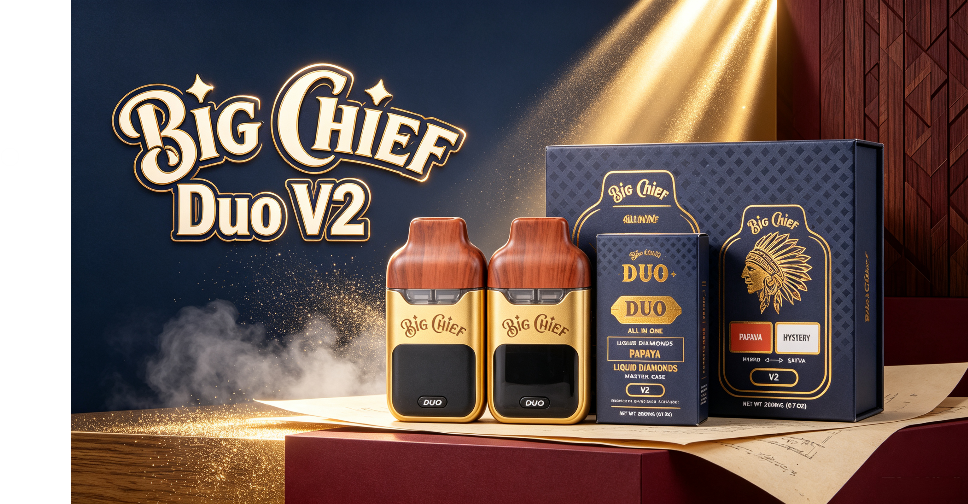
Exploring the Business Case Around Big Chief Duo V2 Disposable THC Vapes: What B2B Buyers Should Verify Before Online Bulk Sourcing
For a consumer, searching for a Big Chief Duo product online may begin with flavor, capacity, or availability.
For a U.S. cannabis procurement manager, the same search should begin somewhere else:
Which version is this? Who is supplying it? Is the product part of an authorized and licensed supply chain? Does the specification match the current brand catalog? And can the hardware support commercial-scale quality requirements?
Those questions are becoming more important as the cannabis vape market undergoes one of its biggest format shifts in years.
BDSA reports that cannabis vape generated approximately $8 billion in U.S. retail sales during the 12 months ending May 2026, representing about 26% of total cannabis retail sales. Disposable sales increased roughly 41%, from $2.7 billion to $3.8 billion, while cartridge sales declined approximately 14%. Disposables surpassed cartridges on a monthly sales basis for the first time in April 2026.
That growth explains why keywords such as disposable big chief duo v2 thc vapes online bulk attract commercial interest.
But the more useful procurement question is not simply whether the category is growing.
It is whether a specific product, version, supplier, and supply chain can withstand professional due diligence.
The First 2026 Buyer Insight: Big Chief’s Current Catalog Has Moved Beyond Duo V2
One of the most important facts procurement teams should know is that Duo V2 is no longer the newest naming used in Big Chief’s current first-party catalog.
As of August 23, 2026, Big Chief’s current online catalog lists products including:
- Big Chief 2G Melted Diamond Cartridge;
- Big Chief 2G Melted Diamond Disposable;
- Big Chief Liquid Diamonds DUO V3;
- and the Big Chief 510 Thread Battery.
Big Chief’s official storefront also currently highlights “DUO V3 ALL IN ONE — Two Strains. One Press.”
That creates an immediate procurement issue.
A buyer searching for Big Chief Duo V2 in 2026 may encounter a mixture of:
legacy inventory, older branded products, third-party listings, empty-hardware products, Duo V2-style hardware, and products whose relationship to the current brand catalog is unclear.
For a purchasing manager, version control therefore comes before price comparison.
Do not assume that two listings using the words “Big Chief Duo V2” necessarily describe the same BOM, the same production generation, or even the same commercial channel.
Why the Disposable Category Still Deserves Procurement Attention
Although individual product versions change, the macro trend behind them is strong.
BDSA describes cannabis vape as an approximately $8 billion U.S. category, with disposable sales growing 41% during its latest 12-month measurement period.
Headset’s current category data separately reports approximately $4.8 billion in U.S. Vapor Pen sales across the markets it tracks from June 2025 through May 2026, ranking Vapor Pens as the No. 2 cannabis category in those markets.
The important point is not the exact difference between measurement methodologies.
Both datasets show that vape remains commercially significant.
For purchasing departments, that means integrated vape hardware deserves the same level of procurement discipline as any other high-volume packaged product category.
The market may reward convenience.
It does not forgive unreliable hardware.
Dual-Format Products Are Part of the Differentiation Race
The Big Chief DUO concept reflects another broader product-development trend: manufacturers are trying to make the device itself part of the merchandising proposition.
A traditional cannabis vape offers one formulation through one reservoir.
A Duo-style architecture introduces two profiles or two reservoirs into one integrated device.
Commercially, the idea can be attractive because it creates:
- more variety per SKU;
- a stronger premium positioning opportunity;
- greater shelf differentiation;
- an interactive switching experience;
- and a more visible product story than a standard single-reservoir device.
For a procurement manager, however, dual-channel hardware also means more complexity.
Instead of validating one fluid path and one heating channel, buyers may need to consider:
Reservoir A + Reservoir B + Heater A + Heater B + seals + switching logic + battery + PCBA + firmware + charging system + airflow.
That is why “two strains in one device” should never be treated only as a marketing feature.
It is also an engineering specification.
More Features Mean More Failure Modes
A sophisticated sample can make an excellent first impression.
Mass production is where the procurement risk appears.
Potential issues in dual-reservoir all-in-one hardware can include:
- inconsistent heating between channels;
- one chamber failing while the second remains functional;
- cross-channel leakage;
- seal failure;
- uneven oil consumption;
- battery voltage drop under load;
- incorrect switching behavior;
- charging failures;
- firmware inconsistencies;
- airflow differences;
- and cosmetic or display defects.
A professional qualification program should therefore test every operating mode supported by the hardware.
The objective is not:
“Does the sample work?”
It is:
“Can the production lot reproduce the approved performance thousands of times?”
Online Availability Is Not the Same as Verified Supply
This distinction becomes particularly important with recognizable cannabis brands.
Big Chief currently maintains its own official online presence and states that its products use authentication measures.
At the same time, searches for Duo V2 return numerous unrelated websites offering products under similar naming.
Some third-party listings describe finished products.
Others explicitly describe empty hardware only, with no THC, oil, nicotine, or other prefilled material.
Those are fundamentally different products and supply chains.
A procurement manager should therefore classify an online listing before doing anything else:
Is this a finished regulated cannabis product?
Is this hemp-derived cannabinoid merchandise?
Is it empty hardware?
Is it a third-party reseller listing?
Is it an OEM-style product using Big Chief-related naming?
Until that distinction is clear, MOQ and price comparisons are premature.
Brand Authentication Should Be Part of Commercial Due Diligence
The appearance of a trademark on packaging does not prove authorization.
Neither does:
a QR code, hologram, authentication sticker, product photograph, social-media profile, or website using the brand name.
For established branded products, procurement teams should connect the transaction to a verifiable commercial chain.
Documentation should clarify:
brand owner → authorized commercial entity → applicable licensed manufacturer/distributor → product batch → buyer.
Big Chief’s official site currently promotes a product-verification function through its digital ecosystem, which gives buyers an additional reason to treat authentication as part of supplier due diligence rather than an afterthought.
Historical Regulatory Records Show Why Traceability Matters
California regulatory records provide a useful example of why product identity and legal supply-chain identity should be evaluated separately.
In a Department of Cannabis Control enforcement decision concerning another operator, DCC records noted that 5,001 Big Chief-branded vape cartridges located during an inspection carried UID numbers that could be traced through California’s track-and-trace system to a licensed microbusiness.
The broader enforcement matter involved issues concerning the inspected licensee, not a blanket finding about every Big Chief product.
For procurement managers, the useful lesson is different:
traceability creates evidence.
When a product can be tied to UID data, production records, a licensed entity, testing documentation, and a specific batch, commercial due diligence becomes much stronger than relying on packaging appearance.
California Buyers Should Verify Licenses Directly
California’s Department of Cannabis Control maintains a public license-search tool that is updated daily.
The database allows businesses to verify whether a cannabis operator has an active license and what commercial activities that license permits.
For B2B buyers, this should be standard procedure.
Do not rely solely on a supplier sending a screenshot of a license.
Verify the current status through the regulator.
An active license can become suspended, surrendered, revoked, expired, or otherwise inactive.
A cannabis purchasing workflow should therefore include current license verification rather than treating compliance as a one-time onboarding exercise.
Product Testing Belongs in the Procurement File
For regulated California cannabis goods, finished-product testing is another essential part of the supply chain.
DCC requires cannabis batches to undergo testing before sale. Required testing covers areas including:
- cannabinoids and terpenes;
- residual solvents and processing chemicals;
- pesticides;
- heavy metals;
- microbial impurities;
- mycotoxins;
- moisture and water activity;
- and foreign material.
Testing laboratories issue a Certificate of Analysis identifying whether the batch passes or fails the applicable requirements.
Licensed distributors also have responsibilities involving COA verification before compliant goods move further through the regulated retail supply chain.
For a procurement team, a COA should therefore be connected to the specific batch being evaluated, not treated as generic marketing collateral.
“Disposable” Can Be an SEO Keyword but a Compliance Problem
There is another important distinction for California marketing teams.
Consumers commonly search phrases such as:
disposable Big Chief Duo V2 THC vapes
and industry websites frequently describe integrated hardware as “disposable.”
California’s regulated terminology is different.
The Department of Cannabis Control describes battery-integrated products as integrated cannabis vaporizers.
Current rules state that packaging and labeling cannot indicate or imply that integrated cannabis vaporizers may simply be disposed of in ordinary trash or conventional recycling streams. Advertising and marketing must also display prescribed hazardous-waste disposal language.
These requirements have applied since July 1, 2024.
That creates an important distinction for SEO teams:
Search terminology and compliant regulated-market terminology are not always identical.
The keyword may make sense in an educational web article.
That does not mean it should automatically be reproduced on product packaging or regulated advertising.
Dual-Chamber Hardware Requires a Stronger BOM
For an OEM or private-label hardware program, component control is especially important.
A locked bill of materials should identify critical components such as:
- battery cell;
- PCBA;
- heating elements;
- reservoir materials;
- seals;
- adhesives;
- airflow components;
- charging connector;
- firmware version;
- and housing materials.
Why lock the BOM?
Because two products can look identical externally while using materially different components internally.
A supplier could replace the battery, heater, seal material, or PCB with a lower-cost part while leaving the exterior unchanged.
That may reduce manufacturing cost.
It can also change field performance.
A commercial OEM agreement should therefore require documented change control for critical components.
Battery Documentation Should Be Non-Negotiable
Rechargeable all-in-one hardware also brings lithium-battery transportation requirements into the sourcing process.
PHMSA states that the lithium battery test-summary requirement applies to batteries contained within products, not only stand-alone cells. Product manufacturers and supply-chain participants must be able to make the required battery information available.
For procurement teams evaluating empty hardware for a lawful application, the battery file should identify the actual cell used in production and connect it with the applicable UN 38.3 test summary.
Do not accept:
“UN38.3 available”
as the entire answer.
Ask whether the documentation corresponds to the exact production battery model.
Component substitution becomes particularly important here.
If the supplier changes the battery cell, existing documentation may no longer represent the production configuration.
Quality Should Be Measured in Rates, Not Adjectives
“Premium.”
“Reliable.”
“High quality.”
“Best performance.”
None of those phrases belongs in a serious supplier-quality discussion unless they can be translated into measurable criteria.
For dual-channel empty hardware, useful procurement metrics may include:
| Quality Metric | Procurement Question |
|---|---|
| DOA rate | What percentage fail initial receiving inspection? |
| Leakage rate | What percentage leak during defined aging/storage conditions? |
| Channel failure | Can both heating channels operate consistently? |
| Charging failure | What percentage fail the charging test? |
| Resistance tolerance | What production range is permitted? |
| Battery capacity | Does production match rated specification? |
| Switching reliability | How many cycles has the selector/control system been tested for? |
| Cosmetic defects | What defects are major, minor, or critical under the AQL plan? |
| Lot traceability | Can defective units be traced to component and production lots? |
| CAPA response | What happens when a batch-level problem appears? |
A qualified manufacturer should be comfortable discussing these questions.
The Current V3 Catalog Changes the V2 Procurement Conversation
The transition from Duo V2 search demand to a current official DUO V3 catalog creates one of the strongest B2B lessons in this product category.
Version names have commercial value.
But they also create inventory risk.
If the official brand has moved to a newer generation, procurement teams researching older V2 inventory should establish:
manufacturing date
exact SKU
commercial channel
hardware specification
authentication status
batch documentation
reason the older version remains available
The answer may be perfectly legitimate.
But the question still needs to be asked.
For a procurement manager, older inventory is not automatically bad inventory.
Unverifiable inventory is the problem.
Why the Broader Market Still Supports Dual-Chamber Innovation
Despite these due-diligence requirements, the commercial logic behind integrated hardware remains strong.
BDSA’s latest data shows U.S. disposable cannabis vape sales growing approximately 41% to $3.8 billion, while disposables overtook cartridges in monthly category revenue during 2026.
The implication for hardware product-development teams is clear.
Retailers and customers increasingly accept all-in-one architecture.
The next competitive layer is differentiation.
That can come through:
dual reservoirs, better industrial design, formulation-specific heating, more reliable electronics, improved battery indication, stronger traceability, or original branded experiences.
But innovation should be evaluated against failure risk.
The best feature is not necessarily the feature that looks most impressive in a sample.
It is the feature that continues working across the production lot.
What B2B Buyers Should Take Away
The phrase disposable big chief duo v2 thc vapes online bulk combines several different purchasing intentions into one keyword.
A professional procurement team should separate them.
Big Chief raises questions about brand identity and authorization.
Duo V2 raises questions about product generation and version control.
Disposable raises hardware, battery, logistics, and—particularly in California—terminology and disposal-compliance issues.
THC places the finished product inside regulated cannabis frameworks where applicable.
Online raises authentication and seller-verification questions.
Bulk magnifies every quality and compliance problem.
That last point may be the most important.
A defect affecting one sample is inconvenient.
The same defect affecting 50,000 units is a supply-chain event.
The Bottom Line
The business opportunity behind Big Chief-style dual-channel all-in-one hardware sits inside a rapidly growing cannabis vape category.
U.S. cannabis vape generated approximately $8 billion in retail sales in BDSA’s latest 12-month measurement, while disposable sales grew around 41% and surpassed cartridges on a monthly basis in 2026.
But buyers researching Big Chief Duo V2 in August 2026 should recognize an important product-development change: Big Chief’s current first-party catalog now prominently lists DUO V3, not Duo V2, alongside its newer vape portfolio.
That makes verification more—not less—important.
Before treating any older branded listing as commercially relevant, professional buyers should establish the exact version, product identity, authorized channel, applicable licenses, batch traceability, testing records, and hardware specification.
For original empty-hardware OEM development in lawful markets, procurement teams should additionally require a production-representative sample, locked BOM, battery documentation, UN 38.3 test summary, QC standards, formulation-compatibility requirements, change-control procedures, and lot traceability.
The biggest benefit of professional online sourcing is therefore not simply access to more inventory.
It is access to more information—provided the buyer knows what to verify.
Next Step for Procurement Teams
For finished THC-containing products, work through the applicable licensed and authorized regulatory supply chain and independently verify brand identity, license status, testing, and batch documentation before any commercial decision.
For companies evaluating empty dual-chamber hardware or an original, non-infringing OEM platform, the next conversation should focus on engineering documentation, battery compliance, production consistency, quality metrics, and change control rather than cannabinoid products or bulk purchasing terms.
That is the type of due diligence that turns a trending hardware concept into a defensible B2B sourcing decision.
If you’re interested in these vapes, you can check out the following popular options : big chief duo v2 disposable vape | big chief wholesale | Dual Chamber Disposable | wholesale vapes