

Donuts Switch V4 Dual Chamber Vape Hardware: What B2B Buyers Should Evaluate Before Bulk Ordering

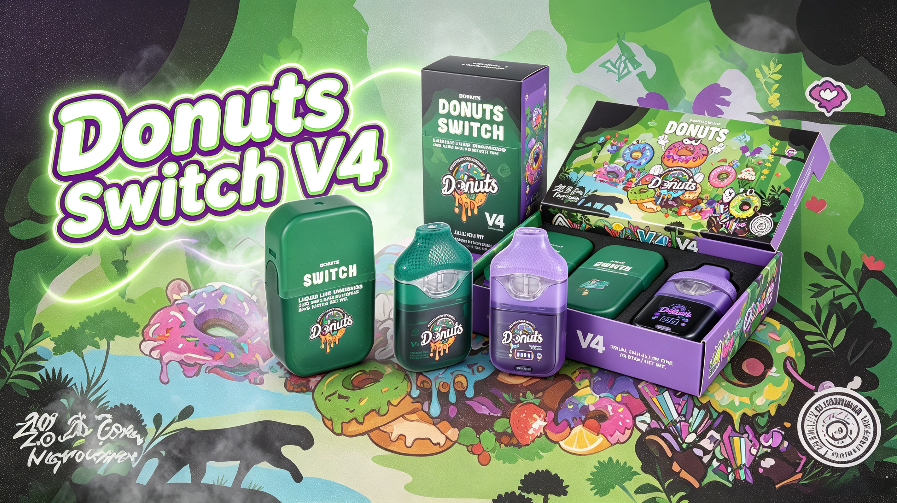
Understanding the Blinking Light on Your Donuts Switch V4 Disposable Vape: Common Causes and Solutions
For a retail customer, a blinking light on a disposable vape is usually a simple question: “Why is my device flashing?”
For a U.S. distributor, cannabis hardware buyer, vape brand, or OEM sourcing manager, the same blinking light raises a much more important question:
Is this normal device feedback—or an early sign of battery inconsistency, coil failure, poor assembly, or an avoidable return-rate problem?
That distinction matters when you are buying hundreds or thousands of units.
The disposable donuts switch v4 is currently being offered by multiple wholesale suppliers as a rechargeable, dual-chamber all-in-one platform with a digital display, preheat function, USB-C charging, and independent or combined chamber operation. One current supplier specification describes a 1+1g dual-chamber structure, a 280mAh battery, two 1.6Ω heating elements, 3.6V output, auto-draw activation, and USB-C rechargeability. The same listing states that the device light flashes when charging is required.
However, experienced procurement managers should pay attention to something else: public specifications are not consistent across suppliers. One current listing states 280mAh, another lists 240mAh, while another advertises a 320mAh battery.
That inconsistency is exactly why understanding the blinking light should be part of a larger supplier-quality discussion—not simply a customer-service FAQ.
First: What Does a Blinking Light on the Donuts Switch V4 Mean?
According to currently available supplier documentation for the Donuts Switch V4, the most clearly documented reason for flashing is low battery / charging required. The product documentation states that the device flashes when charging is needed and uses USB-C charging. When connected to power, the logo illuminates and the battery icon should display an increasing animation; once charging is complete, the battery indicator shows full.
That makes low battery the first condition buyers and customer-service teams should check.
But procurement teams should avoid assuming that every blinking pattern has the same meaning.
Publicly available listings reviewed for this article do not provide a complete manufacturer-issued diagnostic chart defining every blink count, timing sequence, or protection code. That means suppliers should be able to provide the actual PCBA/firmware LED error-code table before a large OEM purchase.
For B2B buyers, a good troubleshooting process therefore looks at both the symptom and the operating condition.
| When the Device Blinks | Most Likely Area to Check | Recommended Action | B2B Significance |
|---|---|---|---|
| Battery indicator is low and device flashes | Battery charge | Recharge with a suitable USB-C connection and confirm the charging animation appears | Normal if isolated; concerning if frequent on new stock |
| Device flashes but charging animation does not appear | USB-C port, cell, charging circuit, PCB | Change known-good charging equipment; quarantine the unit if the problem remains | Potential DOA or assembly issue |
| Problem occurs only when one chamber is selected | Individual coil/channel connection | Compare operation between Chamber A, Chamber B, and dual mode | Possible channel-specific manufacturing defect |
| Device lights normally but produces little or no vapor | Airflow, oil compatibility, coil/wicking performance | Check product compatibility rather than assuming the battery is the problem | Important for oil-hardware matching |
| New units arrive flashing or deeply discharged | Battery storage, shipping condition, cell quality | Record batch number and measure failure percentage before distribution | Supplier-quality warning sign |
| Multiple units from the same carton behave identically | Batch-level manufacturing issue | Stop distribution and request supplier CAPA/root-cause analysis | More serious than isolated customer misuse |
The most important principle is simple:
A single blinking device may be a usage issue. A repeatable blinking pattern across a production lot is a procurement issue.
1. Low Battery: The Most Straightforward Cause
The Donuts Switch V4 is marketed as rechargeable rather than as a traditional one-time battery disposable. Current product documentation indicates USB-C charging and specifically identifies flashing as a signal that charging is required.
From a purchasing perspective, however, battery performance should be evaluated beyond the published mAh figure.
Why?
Because battery capacity claims for the disposable donuts switch v4 currently vary between suppliers. One listing specifies 240mAh, another 280mAh, and another 320mAh.
For a retail buyer ordering 50 pieces, that may appear minor.
For a distributor ordering 20,000 pieces, it can affect:
- usable runtime;
- number of recharge cycles required;
- voltage stability under dual-chamber load;
- customer complaints;
- shelf-life performance;
- DOA rates;
- warranty costs.
Before approving production, ask your supplier to lock the actual battery specification in the purchase order rather than accepting a changing website description.
A professional specification should identify the cell model, rated capacity, nominal voltage, supplier, and production tolerance.
2. A Charging Problem Can Look Like a Battery Problem
If a Donuts Switch V4 continues flashing after being connected to power, the battery itself is not necessarily the only suspect.
The charging path includes the USB-C connector, PCB, battery protection circuit, solder joints, cell, and firmware responsible for displaying charge status.
The documented charging sequence gives buyers a useful diagnostic reference: when power is connected, the logo should illuminate and the battery icon should show an increasing charging animation.
If that expected behavior does not occur consistently across sample units, buyers should treat it as a QC issue.
Do not solve this by repeatedly charging, opening, puncturing, or modifying a questionable device. A unit that becomes abnormally hot, shows physical battery damage, or repeatedly fails to charge should be quarantined rather than placed back into inventory.
For commercial orders, the better question is not:
“Can we get this one unit working?”
It is:
“What percentage of this production batch shows the same behavior?”
3. Dual-Chamber Architecture Creates More Failure Points—and More Product Value
The attraction of the Donuts Switch V4 is its dual-chamber architecture.
Current supplier documentation describes two independent 1g chambers and two 1.6Ω heating elements, with the ability to select individual chambers or operate both simultaneously. The listing states that output increases when both channels operate together.
Commercially, that architecture is attractive because one device can offer two formulations or profiles without requiring two separate pieces of hardware.
Engineering-wise, however, dual-channel hardware is inherently more complex than a basic single-coil disposable.
A buyer now needs consistent performance across:
Battery → PCB → channel selector → Chamber A coil → Chamber B coil → airflow system → display/indicator system.
If the device works normally on one chamber but flashes or fails during another operating mode, the problem may be channel-specific rather than battery-related.
That is an engineering hypothesis rather than a published Donuts Switch V4 error code, which is why OEM buyers should request the supplier’s actual firmware diagnostic logic.
For a serious production program, your supplier should be able to answer questions such as:
What happens when Coil A is open? What happens when Coil B is open? What happens during a short circuit? What does the screen display at low voltage? What protection activates during excessive current draw?
If the answer is simply “the light blinks,” the technical documentation is not yet strong enough for a mature OEM program.
4. Oil Compatibility Can Be Mistaken for an Electronic Failure
One of the most expensive sourcing mistakes in cannabis and concentrate hardware is evaluating an empty vape only with air tests.
A device can pass an initial electrical inspection and still perform poorly after filling.
Viscosity, formulation behavior, storage temperature, wick saturation, coil geometry, inlet design, and airflow resistance all affect real-world performance.
The Donuts Switch V4 is commonly marketed as postless dual-chamber empty hardware, meaning the final performance of a filled unit depends on the relationship between the hardware and the customer’s formulation, not hardware specifications alone.
If the screen activates but vapor output is weak, inconsistent, or absent, do not automatically classify the problem as “low battery.”
For procurement teams, this is why a meaningful sample test should include your intended formulation rather than relying exclusively on factory dry testing.
Your OEM supplier should be willing to discuss compatibility testing, aging tests, leakage observations, heating consistency, and performance after storage.
5. Why Repeated Blinking Complaints Matter More in 2026
The U.S. vape market is not disappearing, but the environment around it is becoming more demanding.
The CDC’s latest available National Health Interview Survey estimate reports that 6.7% of U.S. adults aged 18 and older currently use electronic cigarettes.
At the same time, the latest national youth data show a significant decline in youth e-cigarette use. Current use among U.S. middle and high school students fell from 7.7% in 2023 to 5.9% in 2024, representing approximately 1.63 million students in 2024.
For legitimate adult-oriented suppliers, that combination reinforces an important market shift:
The long-term competitive advantage is moving away from novelty alone and toward product reliability, documented quality control, responsible positioning, and supply-chain discipline.
A flashing display may seem like a minor technical issue, but distributors increasingly operate in an environment where avoidable returns, inconsistent specifications, and poor documentation create unnecessary risk.
6. U.S. Buyers Should Separate Hardware Quality From Regulatory Status
This distinction is essential.
A well-made device is not automatically a legally marketable nicotine product.
As of the FDA’s current 2026 list, 45 e-cigarette products have received FDA marketing authorization, and FDA states that those listed products are the e-cigarettes that may currently be lawfully sold in the United States.
The Donuts Switch V4 name does not appear on that authorized e-cigarette list.
That is especially relevant if a business intends to market the device as a nicotine ENDS product in the United States.
FDA’s May 2026 enforcement guidance reiterates that new tobacco products generally cannot legally be marketed without premarket authorization. The guidance also describes limited circumstances in which FDA generally does not intend to prioritize enforcement for certain unauthorized products with qualifying pending applications; that enforcement policy should not be confused with marketing authorization.
Empty hardware also should not automatically be treated as “outside regulation.”
FDA’s current guidance states that components and parts of ENDS products are subject to its tobacco-product authorities when they fall within the relevant regulatory framework.
Meanwhile, the PACT Act uses a particularly broad definition for shipping and delivery purposes. ATF states that ENDS can include vape pens as well as components, liquids, parts, and accessories, and its definition covers devices delivering nicotine, flavor, or another aerosolized substance.
USPS likewise states that ENDS are generally nonmailable except under authorized exceptions and applicable PACT Act conditions.
For procurement managers, the implication is straightforward:
Never let a supplier use the phrase “empty vape hardware” as a substitute for a real U.S. compliance review.
Product classification depends on intended use, product configuration, claims, destination, and applicable federal, state, and local rules.
7. Enforcement Risk Is Now a Supply-Chain Issue
Regulatory diligence is no longer only the manufacturer’s concern.
In September 2025, the U.S. Department of Justice announced the seizure of more than 2.1 million unauthorized vaping products from five distributors and six retailers across seven states.
Earlier in 2025, FDA and U.S. Customs and Border Protection reported seizing illegal e-cigarettes with an estimated retail value of $33.8 million during a joint operation. FDA said almost all of the shipments involved in that operation originated in China, and some shipments allegedly used vague descriptions or incorrect declared values.
FDA currently reports more than 800 warning letters to firms involving manufacturing, selling, or distributing new tobacco products without marketing authorization and more than 1,000 warning letters to retailers for unauthorized tobacco products.
That changes how professional buyers should evaluate suppliers.
The lowest unit quotation is not necessarily the lowest landed risk.
Documentation, truthful customs descriptions, traceable manufacturing, market-specific compliance knowledge, and reliable after-sales support increasingly belong in the same purchasing decision as price.
8. Battery Documentation Should Be Part of Every RFQ
The blinking-light issue also highlights another frequently overlooked procurement requirement: lithium battery transportation documentation.
The U.S. Pipeline and Hazardous Materials Safety Administration states that lithium cells and batteries offered for transportation must have passed the applicable UN Manual of Tests and Criteria, Section 38.3 design tests. PHMSA also states that lithium-cell and battery manufacturers must make test-summary documents available upon request.
Therefore, when sourcing a rechargeable disposable such as the Donuts Switch V4, asking only for:
“How many mAh?”
is not enough.
Ask instead for:
UN 38.3 test summary, battery specification sheet, cell supplier information, MSDS/SDS where relevant to the logistics channel, batch traceability, and confirmation that the cell used in mass production matches the cell represented in the test documentation.
This is particularly important when public listings for the same model already show conflicting battery capacities.
9. What U.S. Procurement Managers Should Ask Before Ordering Donuts Switch V4
A professional RFQ for disposable donuts switch v4 hardware should go beyond price, MOQ, and delivery time.
Before approving a bulk order or OEM project, ask your supplier for:
- a locked specification sheet showing actual battery capacity, resistance, voltage, chamber capacity, materials, and charging configuration;
- a golden sample that represents the exact mass-production BOM;
- the complete LED/display and protection-code table;
- UN 38.3 battery documentation and traceable cell information;
- incoming-material and outgoing-QC procedures;
- AQL standards and documented defect classifications;
- sample results for charging, leakage, activation, chamber switching, and storage aging;
- compatibility testing using your intended formulation;
- a defined DOA and warranty policy;
- batch/lot traceability;
- packaging and labeling options appropriate for the intended legal market;
- confirmation that the supplier will not substitute battery cells, coils, PCBAs, or materials without written approval.
This type of documentation tells you much more about a supplier than a polished product photo.
10. How to Evaluate a Supplier When the Price Difference Is Only a Few Cents
The wholesale market often pushes procurement teams to compare products primarily by unit price.
That can be misleading.
Imagine Supplier A is $0.15 cheaper but generates a 4% field-failure rate, while Supplier B costs slightly more but provides a locked BOM, lower DOA rate, clear QC records, replacement support, and consistent battery sourcing.
For a serious distributor, the second supplier may deliver substantially better gross margin after considering replacements, customer-service labor, freight, retailer credits, and damaged account relationships.
A blinking light becomes expensive when it happens across thousands of units.
This is why professional sourcing should evaluate total cost of quality, not simply FOB price.
The Bottom Line
A blinking light on the Donuts Switch V4 may be nothing more than a low-battery reminder. Current product documentation specifically identifies flashing as a charging signal.
But for B2B buyers, the more valuable question is what happens after charging.
If the problem disappears, the device may be operating normally.
If the same problem appears repeatedly across samples, one chamber, one production lot, or one shipment, it may reveal something far more important: inconsistent cells, PCB problems, coil-channel defects, formulation incompatibility, weak production controls, or inadequate supplier documentation.
And in today’s U.S. market—where FDA authorization, enforcement, shipping restrictions, battery transportation requirements, and state-level rules all influence commercial risk—hardware sourcing cannot be separated from compliance and supply-chain management.
Looking for a Donuts Switch V4 OEM or Bulk Hardware Partner?
If you are evaluating disposable donuts switch v4 hardware for wholesale distribution, private labeling, custom packaging, or an OEM program, start with documentation before negotiating the final cent of unit price.
A qualified supplier should be able to discuss the actual battery specification, dual-chamber architecture, QC process, production consistency, battery transport documentation, sample testing, packaging customization, lead time, and after-sales policy—not simply send you a price list.
For your next sourcing inquiry, provide your target order quantity, intended market, formulation requirements, packaging needs, and OEM specifications, and request a production-representative sample plus the supporting technical and quality-control file before placing a bulk PO.
That is the fastest way to determine whether a supplier can deliver more than a competitive price—and whether they can become a dependable long-term manufacturing partner.